Showing posts with label George G. Gilman. Show all posts

Friday, 21 July 2023

THE BURNING MAN


JUBAL CADE
Book 6 of 22
THE BURNING MAN
By Charles R. Pike
Cover art by Richard Clifton-Dey
Mayflower/Granada Publishing, 1976
ebook, Piccadilly Publishing, July 2023

The negro hung from the flaming cross and watched. In front of his burning cabin the white-robed figures of the Klu Klux Klan repeatedly raped his wife. Then came Jubal Cade to spit death from his .30 calibre Spencer . . . 

When they post the reward for the capture of the Klan’s Grand Dragon, the bounty-hunters flood into St Louis. But Jubal Cade is there before them. He has seen the Klan’s savagery first-hand. And Jubal is a man who knows all about vengeance.

Cade gets involved with the Klan whilst visiting Andy Prescott, the young blind boy Jubal has taken under his wing. Cade is constantly trying to raise money so Andy can have medical care and now there’s a chance an operation will restore Andy’s sight. The money Cade could secure by bringing in the Klan’s leader would pay for that operation, and when the Klan kidnap the head of the clinic, Cade has two reasons for destroying the Klan.

The author behind the pseudonym of Charles R. Pike is Angus Wells and he brings together a lot of the series threads for this tale. Being in St. Louis brings Cade face to face with the man who has sworn to have Jubal killed, Ben Agnew. Now they have a common enemy. Can they put the past behind them for a while to take on the Klan and unmasked the Grand Dragon?

Like in many of the books written by the group of authors now known as the Piccadilly Cowboys, there is lots of references to them and the western characters they wrote about. Many of the characters names in this story are made up from combinations of these authors names and other people in the book publishing business. For instance, a fair portion of this tale takes place on a sternwheeler and this boat is named the William M. James – the author name fronting the Apache series.

Although Angus Wells wrote most of the books in this series he didn’t write the first three or create the character of Jubal Cade. Terry Harknett started the series, an author probably better known to western fans as George G. Gilman whose hero Edge is a favourite of many readers. Edge appears in person in The Burning Man, stepping out of the shadows to shotgun a man to death, saving Cade’s life. Edge and Jubal have a conversation that references a very well-known spaghetti western character a couple of times, and this exchange of words is one of the highlights of the book for me. 

I once asked Terry if he had anything to do with Edge appearing in this book and he said he couldn’t remember much about how it came about but did entertain the possibility that he wrote this section, or co-wrote it with Angus. If he didn’t, Angus captured the character of Edge extremely well, not just in action but also in his speech and gallows humour. 

The Burning Man contains lots of violent bloody action, something that Well’s excels at in his gory descriptions. With Cade being a doctor Wells has opportunities to describe in detail Cade’s attempts to save lives too. Wells doesn’t give Cade an easy ride of it either, Jubal has to endure suffering, not due to physical wounds, but mentally – to say more would be a major spoiler so that’s all I’m going to reveal here. To add some light-relief to the more brutal scenes, Well’s includes lots of groan-worthy humours comments, mainly coming from Jubal, that had me laughing out loud at times.

The Burning Man is a very good entry into this excellent series. This book is a must read for anyone following the series due to its connections with earlier books plotlines and a character Cade met in book five have roles to play in this story too. The inclusion of Edge in this story makes this book essential reading for fans of George G. Gilman’s most famous character as well as those who enjoy Angus Wells’ work.

American readers can get a copy here
British readers can get a copy here

Sunday, 7 May 2023

A TOWN CALLED BASTARD

A TOWN CALLED BASTARD
By William Terry
NEL, 1971

Revolutionaries massacre a church congregation and destroy its interior. From that day onwards the town becomes known as Bastard.

Some years later Bastard is under the control of bandits masquerading as revolutionaries who kill on the slightest whim. A priest is trying to rebuild the destroyed church and the townspeople live in fear. 

A fancy hearse arrives in town, its female owner searching for the man who killed her husband. The woman promises to pay $20,000 in gold if the man who killed her husband is found and delivered to her so his corpse can be placed in the coffin the hearse is transporting. The bandit leader wants that gold, so sets out to find the unnamed killer. Could it be the mysterious man of legend Aguila? Does Aguila even exist?

Further violence will erupt when a brutal army Colonel arrives on the scene searching for an elusive rebel leader and no-one is safe from his savage methods to find the man he seeks.  

Based on Richard Aubrey’s screenplay for the spaghetti western of the same name, William Terry does an excellent job of capturing the mood and viciousness on the movie. There are a few scenes in the book that don’t appear in the movie and I don’t know whether the author added these himself or they were including in the screenplay and were omitted from the final cut of the film. 

There are some great characters to be found in this story, The Priest, Don Calos, Alvira and her bodyguard, Spectre, to name but a few. Terry captures the harshness of this tale in a very visual way and fleshes the characters out a little more than is done in the film. I seem to remember watching the movie many, many years ago and thinking it didn’t make much sense but the author fills in the gaps so it is much easier to follow. Maybe the censor was responsible for the film being uneven? 

Violence is graphic, and the author seems to have added some sexual scenes that don’t appear in the film to spice the book up, but these aren’t graphic. They do help explain why some of the characters act the way they do. There are a few neat twists to the tale before the book ends as brutally as it began.  

I must say I much prefer the book version to the film, which was also known as A Town Called Hell in some countries. 

William Terry is a pseudonym for author Terry Harknett, perhaps better known for his Edge westerns written as George G. Gilman. 

The movie starred Robert Shaw, Stella Stevens, Telly Savalas and Martin Landau. It was produced by S. Benjamin Fisz and was directed by Robert Parrish.


Tuesday, 27 December 2022

APACHE DEATH


EDGE
Number 3 of 61
 + 3 Edge meets Steele books + mini-series Edge: The Return, 6 books
By George G. Gilman
Cover art by Ricard Clifton-Dey
NEL, May 1972

The year is 1866. The region is the Arizona Territory. The town is called Rainbow.

The cavalry are there. So is an English gambler. So is Edge. Outside the town waits Cochise and his Apaches.

They are all together at Rainbow’s end.

This book has an extremely high death count as the Apache are determined to wipe the white man out. Farmsteads and ranches are swept aside. People are butchered horrifically. Edge arrives at one such farmstead and views the remains of the slain. Realizes one of the famers daughters has been taken prisoner but there is nothing he can do about it.

Arriving in the town of Rainbow, which is built by a Fort also called Rainbow, Edge meets the English gambler and is soon lured into a hunt for one million dollars that is buried somewhere in the vicinity. With hundreds of Apaches swarming the area, the money isn’t going to be easy to find. And then the Apaches attack the town.

George G. Gilman is still developing the character of Edge but all the main elements are to be found. He’s hard, very hard, and only believes in looking out for himself. He’s quick to act and give orders – which doesn’t go down well with the Fort’s commander. The gallows humour is there but not every chapter ends with a pun as it will in later books. The violence is extremely graphic and some of the torture scenes will make you cringe. Not many of the main, and support, characters will survive. 

Apache Death was always one of my favourites in the Edge series, and after reading it again, it still remains so. The cover art has to be one of the greatest of the entire series. 

George G. Gilman was a pseudonym used by Terry Harknett.

Monday, 14 February 2022

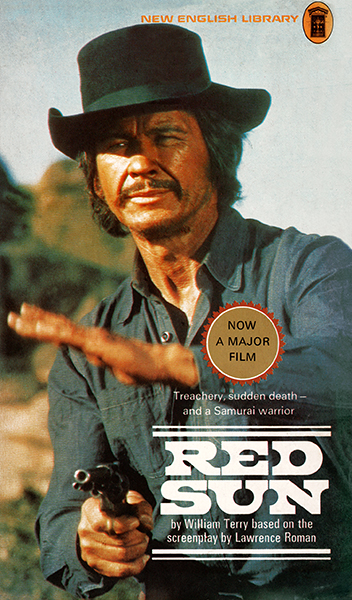
RED SUN


By William Terry
NEL, July 1972

A train carrying a Japanese delegation with a golden ceremonial sword for President Grant is robbed by outlaws led by Link and Gauche. When Gauche double-crosses Link and leaves him for dead, Link is ordered to team up with Kuroda, one of the ambassador's samurai bodyguards, who has a week to recover the sword or commit 'hara-kiri'. Kuroda will also kill Link before taking his own life. Hoping to find out from Gauche where the gang buried the loot from the train before Kuroda can kill him, Link tries to unsuccessfully escape from the samurai. Soon a truce is formed between the American and the Japanese samurai and they close in on Gauche but a new threat is waiting for them all, a band of Comanche warriors eager to take all their lives.

One of three film novelisations written by William Terry, whose real name was Terry Harknett, whom westerns fans will know better as his pseudonym George G. Gilman behind which he wrote the extremely successful Edge series. 

Terry told me that his movie novelisations were based on the screenplays and that he didn’t get to see the film before writing the book. He was also given information on who would be starring in the film so he could base his characters descriptions on them. When reading this book, it is very easy to imagine the actors in the leading roles, and hear their voices too. 

The clash of cultures makes for some humorous scenes that add a light-hearted feel to the story but it is not a comedy western. The plot is simple yet entertaining and the many action scenes can be quite brutal at times although nowhere near as graphic as Harknett’s series westerns. 

If you’ve seen the film or are a fan of Terry Harknett’s writing, then this is a must read for you. If you like stories where cultures clash then this is a tale you will probably enjoy. I also think anyone who likes westerns should find this a worthwhile read. 

Red Sun is a 1971 Franco-Italian Spaghetti Western that was directed by Terence Young (better known perhaps for his James Bond films). Red Sun starred Charles Bronson, Toshirō Mifune, Alain Delon and Ursula Andress. The original screenplay was by Denne Bart Petitclerc, William Roberts, and Lawrence Roman, from a story by Laird Koenig. 


Wednesday, 9 February 2022

THE VIOLENT LAND


JUBAL CADE
Number 21 of 22
By Charles R. Pike
Cover art by Richard Clifton-Dey
Granada Publishing, 1983

If Cade hadn’t wanted so badly to track down the man who murdered his wife, he probably would never have ventured into the mountains in such weather. Probably would never have found a couple of lovers crucified on a tree, or been taken by the crazed Ezekial to the weird lost valley which the iron rule of a fierce religion dictated that he should never leave alive . . .

But he did want to find the murderous Kincaid, and he had found the valley. Now, if he wanted to live, he would probably have to kill.

A series begun by author Terry Harknett, who many will know better as George G. Gilman, but from number four the books were all written by Angus Wells, except book 11 which was by Kenneth Bulmer. Harknett said he hadn’t the time to write any more of them after the first three due to other series commitments so happily passed the series over to Wells.

Wells continued with the theme of Cade searching for his wife’s killer, started by Harknett, throughout the series, giving the doctor a reason to be wandering all over the West. Wells soon made the series his own, stamping his very readable style on the books. Of the authors that would become known as the Piccadilly Cowboys, Wells wrote the goriest graphic scenes. Having a doctor as an anti-hero gave Wells the excuse to really get creative in his descriptions of violence and attempts to save people’s lives.

It's the fact that Cade is a doctor that keeps him alive once captured by Ezekial, as he is sick and isn’t ready to die, but even so it’s a fine line Jubal walks between life and death throughout the story. 

After discovering the hanged man and crucified girl, Cade tries to save the latter as she’s just clinging to life. A vicious wolf pack attack adds to Cade’s problems and he’s saved by Ezekial, only to be taken to a hidden community from which he isn’t allowed to leave - ever. Most of the rest of the story revolves around Jubal planning to escape and then putting his plan into action. He doesn’t make his bid for freedom alone, there are others that tag along and they are soon pursued by Ezekial and his right-hand men. The end of the book finishes just as violently as it began in a savage showdown that few will survive.

For followers of this series or fans of Angus Wells’ work, you’ll want to read this book. For those new to the series, it’s a fairly good entry point, even if it is the second-to-last book in the series, as it includes many of the elements the series is known for – good writing, an interesting plot, well crafted characters, bloody violence and detailed medical procedures. This one also contains some great religious speech as Ezekial uses the teachings of the Lord to justify his rules and Cade fires back quotes that make Ezekial doubt himself.

Having read all the books in this series a number of times, I would say it is certainly one of the stranger plotlines, and it’s more than entertaining for that reason alone. I wouldn’t say it was one of the best Jubal Cade books but it’s certainly a fun read.

I must mention the cover art, as this for me is one of the best covers of the entire series – all painted by Richard Clifton-Dey. 

Thursday, 15 March 2018

Hot Lead - issue one


Issue one of Hot Lead, a new hardcopy western fanzine is now available via Amazon.

This first issue contains 60 pages and all about the books written by a group of writers known today as The Piccadilly Cowboys. Inside you will find an interview with Terry Harknett, who wrote mostly as George G. Gilman and under this pseudonym put out the following three series, Edge, Adam Steele and The Undertaker.

You’ll also find detailed looks at both Herne the Hunter and Crow, along with a review of one book from every Piccadilly Cowboy series.

Hot Lead has been put together by editor Justin Marriott, ghost editor Paul Bishop with contributions from myself, Steve Myall.

Issue two is almost ready to go and will feature the Art of the Western and issue three will be about the American Adult Westerns.

So, please grab a copy and help make this fanzine a success.


Thursday, 1 March 2018

Three Graves to a Showdown

THE UNDERTAKER #4:
By George G. Gilman
NEL, January 1982

Brought up with death, he learned to kill.

Suddenly there were a lot of folks wanting to meet up with Barnaby Gold.

The man on the Trans-Territorial Stage for a start. He got his meeting – a short one. One item only on the agenda and a final conclusion. Very final.

The woman, too. She wanted a meeting, though of a rather different sort. She was luckier. Got what she seemed to be looking for.

But the final meeting was the one that Gold himself wanted. One he’d been seeking for a very long time. No ordinary meeting. Not when the preparations included three new coffins and three freshly-dug graves.

Barnaby Gold, The Undertaker, is perhaps George G. Gilman’s coldest character, a man who will stop at nothing to achieve his aims, as he points out during this story, there are ‘just two kinds of men I kill. Those that are trying to kill me. And those that get in the way of me doing what I want to do.’

Gilman includes enough backstory to fill in those who haven’t read the previous books to explain why Gold has a ten-thousand-dollar bounty on his head, which in turn enlightens new readers as to what drives the man known as The Undertaker towards the final confrontation he engineers, and this is done in a macabre style that makes for a dramatic last showdown.

The Undertaker is, perhaps, Gilman’s least known western series, coming some years after Edge and Adam Steele. This, the fourth book was meant to be the last and the ending certainly reads like it could have been, and for me would have made for an excellent conclusion to the series, but the publisher persuaded the author to write two more.

Like Edge with the razor he carries behind his neck and Steele with his stick-pin and thugee scarf, Barnaby Gold has an unusual weapon, a swivel Peacemaker, and he also has another gimmick; his screw together shovel that he uses to bury all those he kills, in fact insists on doing so. 

Filled with tough-talking and acting characters this story races along at great pace, offering a couple of surprising revelations along the way. For those who have read the other Gilman series’, you’ll find less of the groan inducing puns, and the graphic violence somewhat toned down, but that is not a criticism in any way for this book is highly entertaining and a must read for all Gilman fans.


Saturday, 27 May 2017

Massacre at Red Rock

By Jack Martin
The Crowood Press, May 2017

Liberty Jones is tired of war – he fought hard in the Civil War, saw great suffering and endured much himself. Now all he wants is to be left in peace, but trouble has a way of finding him. He rides into the town of Red Rock to escape a marauding tribe of Indians, but any hopes of safety he may have held are soon dispelled. For the town is under military command and facing a gathering of great Indian tribes who are determined to drive the people from the town and reclaim their land.

Liberty, along with a rag tag band of townspeople, must face impossible odds and soon blood will run deep in the streets of Red Rock.

Massacre at Red Rocks is a very fast paced book that is more or less filled with non-stop action as the mix of Indian tribes launch attack after attack on the town. There are brief explanations as to why the military won’t give up Red Rocks and why the Indians are so determined to destroy the town.

Jones is at first at odds with Captain Roberts but this soon becomes a grudging respect as the fighting ability of Jones becomes apparent to the soldier. There are one or two lighter moments amidst the carnage, such as when Jones and the English gambler, Sinclair, get arrested. This leads to the pair meeting an old-timer in jail which gives birth to the tales' sub-plot.

There are a couple of tips of the hat towards favourites of the author, such as naming the English gambler Lord Simon Sinclair – a mix of names of two of Roger Moore’s famous television characters, Simon Templar (The Saint) and Lord Brett Sinclair from The Persuaders. Knowing that Jack Martin is also a massive fan of the third Edge book, Apache Death, by George G. Gilman, there are certainly nods of the head to that story too. All of this added to my enjoyment of the story.

Jack Martin is a pseudonym used by Gary Dobbs, and he has certainly come up with a very entertaining tale that should satisfy all of us who like stories packed with action.


Sunday, 28 December 2014

Ebook News

John Legg, who has had many westerns published under both his own name and a variety of pseudonyms, is now putting some of his back catalouge out as ebooks and is releasing some brand new work alongside them. You can find an interview I did with him here.


January 5th 2015 sees the publication of the first three in a brand new multi-author adult western series called Blaze! All three are available for pre-order.
"J.D. and Kate Blaze are two of the deadliest gunfighters the Old West has ever seen. They also happen to be husband and wife, as passionate in their love for each other as they are in their quest for justice on the violent frontier!"


Paul Lederer has now made is highly acclaimed five book Spectros series available as ebooks. Whilst not strictly Westerns as they cross the genre with fantasy they have always appealed to western fans, so if you fancy something a little bit different then these are well worth your consideration.


Tony Masero continues to put out brand new material, both series westerns and stand-alones. Tony is perhaps better known as a cover artist first rising to prominence in the western field when he painted the U.K. covers for George G. Gilman's books. As well as painting his own covers his excellent artwork can be seen fronting many of Piccadilly Publishing's releases. An interview with Tony can be found here.


Sunday, 17 August 2014

Hannie Caulder

By William Terry
NEL, September 1971

Fleeing the scene of a botched bank robbery, the Clemens brothers come across an isolated homestead. Attempting to steal fresh horses, the trigger-happy youngest brother murders Caulder, the landowner. His wife Hannie is unable to fend off the three Clemens alone. They rape her, steal her horses and burn her home to the ground. Determined to seek revenge Hannie teams up with Thomas Price a ruthless bounty hunter. She implores him to teach her how to kill. Reluctantly he agrees and together they set off in pursuit of the outlaws.

This is the book of the film rather than a book that became a film. The author, William Terry, based the book on the screenplay which in turn was adapted from an original story by Peter Cooper.

William Terry is a pseudonym used by Terry Harknett, who would become much better known the following year as George G. Gilman when the first in the best-selling Edge western series was released, a series that would run for seventeen years.

Terry tells me he wrote the book from the final draft of the script the director would be using to make the film. He knew who was to star in the film and was sent some black and white stills of key scenes which is why his descriptions of characters is spot on. Dialogue was taken from the script and it’s intriguing to discover this contains a lot of gallows humour which would become a trademark of Terry’s own books, something he freely admits he was influenced by along with many other TV and film westerns he watched and was ‘enthusiastically encouraged by the editorial team at New English Library!’ to continue using this in his own westerns.

The story is a straight-forward revenge tale and mixes the dark theme of Caulder’s rape and subsequent quest for vengeance with lighter comic moments mainly through the antics of the Clemens brothers. Terry’s writing perfectly captures the spirit of the film and its changing tones.

The book was published around the time the movie was released and is a must read for fans of both the film and Terry Harknett’s work as well as those who enjoy fast-moving westerns that mix violence and humour.

The film is a British production directed by Burt Kennedy and starred Raquel Welch as Hannie Caulder. It also stars Robert Culp, Ernest Borgnine, Strother Martin, Jack Elam, Christopher Lee, Diana Dors, and Stephen Boyd.


Friday, 22 June 2012

The First Death


APACHE #1:
By William M. James
NEL, March 1978

First published by Pinnacle, 1974 
(cover shown below)

In the great tradition of Cochise and Geronimo, Cuchillo is a warrior to be feared. But he is not a man easily driven to war. When the brutal and sadistic Lieutenant Pinner removes two of his fingers for allegedly stealing his ornamental knife, and brands him Cuchillo Oro (Golden Knife), he seeks a peaceful solution. When the true thieves come after him, even then, he keeps his head. But when Lieutenant Pinner takes his squaw and his baby boy hostage – then the white eyes have gone too far… 

Pinnacle published George G. Gilman’s very successful Edge series in America and saw them agree to publish a new series written by the man behind the Gilman pseudonym, Terry Harknett, and Laurence James. In fact the series idea came from the latter. Both these English authors, alongside a couple of others would latter become known as the Piccadilly Cowboys. When Terry decided to stop writing for this series his place was taken over by John B. Harvey, another of the PCs. The series ran from 1974 to 1984 and saw the publication of 27 books. Only the first 12 were published in the authors’ home country. The first book I’m reviewing here being written by Terry Harknett. 

This opening novel deals with the misunderstandings that lead to the tragic deaths that will set Cuchillo on the vengeance trail in the following books. It also explains how he gets his new name, Cuchillo Oro, and how he comes to carry the bejewelled knife. 

The book is superbly paced, full of well-crafted characters, and savage bloody action. There aren’t any white-hat heroes here, just hard men, and women, struggling to survive. Sympathies lie with the Apaches, as to be expected in a series with one of them as the lead character, and the soldiers are painted, mainly, as vicious, heartless, men who think nothing of torturing and raping, who take great pleasure from doing this, so it isn’t long before the reader is urging Cuchillo to victory. There is one white man who is a friend of Cuchillo, teacher John Hedges, a man who will turn up from time to time in later books.


For those who’ve read the Edge books and are aware of the groan worthy, grin-making, one liners of gallows humour Terry Harknett always included you’ll be pleased to discover he continues that tradition here, not as often but just as good, or bad, depending on your point of view.

The book ends with a very violent rescue attempt that leads to a couple of horrific killings that sees the story end with a promise that paves the way to the next book in the series and will leave you wanting more.

Due to its continuing storyline I’d suggest reading the books in order to get the greatest enjoyment from them.

Cuchillo Oro is Apache. 
Brutal
Unrelenting…
and Deadly.

Sunday, 15 May 2011

The Riflemen

By Tony Masero
Solstice Westerns, April 2011

Mexico, 1868. Two men. One white, one colored. Proficient in shooting with the long arm, the greatest long-range weapon of the age. The .50 caliber Sharps rifle.

The ex-sharpshooters Nick Guardeen and Thaddeus Johnston receive an invitation from the Arizona State Governor. He offers them something they’ve never had before: land. So, for the promise of their very own homestead, they accept a highly dangerous mission across the border into Mexico.

Hounded by a merciless gang of assassins, they press on into the desert redoubt of the self-styled and ruthless General Wyatt whose crazy ambition is nothing less than reinstating the Confederacy. Their only assistance comes from the beautiful and mysterious Christine Lenoir. She risks all as a spy in the heart of the renegade fortress, driven by her hatred for the General.

Nick and Thaddeus need all their skills and fighting technique to survive against Apaches, murderers and a reinstated army of rebel forces.

To my knowledge this is the first published western by Tony Masero. His name will be instantly recognizable to many western fiction fans though, particularly those in the UK. Why? Because he is best known as an artist, the man who painted the covers for the highly regarded George G. Gilman series: Edge, Adam Steele, and The Undertaker. His artwork also appears on many other books and has recently begun fronting Black Horse Westerns.

So what is Tony like as an author? Very good is the quick answer.

The Riflemen is a fast moving tale that’s packed with action as the two ex-sharpshooters take on vast odds. Their characters have been carefully thought out and you’ll soon be urging them on to complete their mission. They aren’t the only memorable characters though; Black Band Doolin, Cave Wyatt, Billy Ray Laforge, and Christine Lenoir, will stick in the mind too, all for very different reasons, the latter of these adding intrigue to the story, as to why she wants revenge against Wyatt.

Tony Masero sets scenes well with brief but detailed enough descriptions that paint vivid imagery of the locations his story is played out in. Dialogue is handled confidently, and often has touches of humour within it. The story builds well to its action-packed final chapters – Billy Ray’s downfall providing a great laugh.

After finishing the Riflemen I’ve found myself hoping it isn’t too long before another book appears from Tony Masero.

Thursday, 23 December 2010

A Christmas Western

EDGE #28:
EVE OF EVIL
By George G. Gilman
NEL, September 1978

To the townspeople of Rayne, Wyoming, the coming Christmas was going to be very special. They reckoned they were about to witness the birth of the new messiah.

Edge did not. There were the shepherds, the three wise men and one or two miracles sure enough, but there was also the Lassiter gang, the robbery and the killings. And to Edge, once again fighting for his life, that did not add up to a nativity.

I first read this book when it was published all those years ago and it left a lasting impression on me then. It’s probably not the best Edge book but it sure falls into the category of those with the strangest plots, and it’s this storyline that makes it so memorable. In fact I can’t remember ever reading any other western with a similar plot either.

The whole story takes place over two days, Christmas Eve and Christmas Day. The book contains all the elements you’d expect from an Edge story: fast pace, lots of violence often graphic in its description, and loads of gallows humour.

Even the sceptical Edge begins to wonder about the chain of events that sees him become involved with Joseph and Maria – who is about to give birth at any moment - a group of shepherds, a dead man named Starr lying to the east, and a priest and his woman named Angel. But it’s the three Oriental wise men who are the source of some of the best lines in the book. For instance these, when it’s realised they haven’t arrived with gifts:

‘They was supposed to bring gifts,’ Basset growled.
‘Frig the heathen bastards!’ the deputy named Frank snarled. ‘We don’t need ‘em. I got my gold watch I can give the baby. Sheriff?’
Karnes delved into a pants pocket and brought out some loose change. ‘I didn’t count on takin’ no trip today. I just got a dollar, Frank. In cents.’

And does this tale finish with the rebirth of Jesus Christ? Well that is something I can’t reveal here other than say the birth of the baby provides a great finale to the story.

If you want a Christmas themed western to read at this time of the year I’d say Eve of Evil should definitely be one you should consider, I’m sure you’ll find it just as entertaining as I did.

Tuesday, 24 August 2010

Western Fiction News

EDGE first appeared in 1972 and continued until 1989. The EDGE series ran for 61 books and the half-breed teamed up with one of George G. Gilman’s other anti-heroes, Adam Steele, in 3 more books. The series sold in excess of eighteen million copies.

Today these westerns are much sort after, particularly the latter books in both series – the final EDGE book often commanding a three-figure sum on auction sites.

Now EDGE is available to buy once more as ebooks. The covers carry new artwork from the artist, Tony Masero, who painted the UK covers all those years ago.

The first book in the series, The Loner, is available now for just £2.01 ($3.11). Get it direct from the publisher Solstice or sites such as Smashwords. The books will also be available from other major Internet booksellers soon.


The latest issue of Black Horse Extra is now available, and as usual features a wonderful mix of articles and comments. Chap O’Keefe introduces readers to one of his series characters, Joshua Dillard. Matthew Mayo talks about how his hopes to see his books published by Dorchester have taken a blow with the publisher’s announcements to switch to ebooks, and Greg Mitchell continues his examination of the artwork of Frederick Remington. Along with these there is the usual selection of news items that cover a broad variety western topics.


Sky Movies magazine has done a four page feature to tie in with their Westerns Week at the end of September. Picking some of their favourite stars from the western genre they’ve named them thus:

The Anti-Hero – Clint Eastwood
The Deputy – Dean Martin
The Loner – Gary Cooper
The Icon – John Wayne
The Cowgirl – Jane Russell
The Villain – Lee Van Cleef
The Gent – James Stewart

Along with this they’ve picked five must see western moments and these are:

The Duel –The final showdown with the winding down musical pocket watch in For A Few Dollars More.
The Exit – Wayne’s Ethan walks away from the home at the end of The Searchers.
The Gunfight – The final bloody shootout that ends The Wild Bunch.
The Punch-Up – The fistfight in Blazing Saddles that spills from the western set into other sets and buildings.
The Song – As the heroes await death in Rio Bravo.

Friday, 30 October 2009

The Staked Plains

as by Billy Moore
A Black Horse Western from Hale, October 2009

When buffalo-hide hunter, Quentin McLeod, rescues Carlotta Mainord from Comanche raiders, their struggle is still far from over. They must face further hostility from the Indians, flash floods and white brigands, only to find themselves in even greater danger when they arrive in the apparent safety of New Mexico.

Carlotta Mainord is attacked and left helpless in a coma and McLeod is blamed and accused of being a Comanchero. Can he convince the hanging jury of his innocence and will he escape the lynch mob in time?

The story begins in the middle of McLeod’s rescue of Carlotta and provides some excellent action sequences, as does the subsequent flight for freedom. During this Billy Moore spends time fleshing out his two main characters’ back story and develops the growing attraction between them – Carlotta at first mistrusting McLeod’s motives: after all he was a Galvanized Yankee!

Once McLeod finds himself held prisoner by the US Army, the story changes pace a little and becomes a war of words in a fascinating and suspenseful trial. Billy Moore introduces two real characters here that help with McLeod’s defence, these being Charles Goodnight and Oliver Loving.

Billy Moore has also come up with a wonderfully evil bad guy, Ian Richards, who seems one step ahead of everyone, even though he’s seen to be slowing slipping into the grip of craziness.

The book finishes with a frantic escape bid that ends in a dramatic, and memorable, scene.

I don’t know anything about Billy Moore – even if this is the authors real name or a pseudonym – and it looks like The Staked Plains is his first Black Horse Western. On the strength of this book I’ll definitely be keeping my eye out for more.

For those interested in cover art this book features a painting by Tony Masero (he who painted the majority of the covers for George G. Gilman’s westerns in the UK).

The Staked Plains has its official release on October 30th, and I’d suggest getting your order in soon, before it sells out.

Wednesday, 24 December 2008

Jubal Cade #17

 BLOODY CHRISTMAS
as by Charles R. Pike
Granada, 1981

Winter in the Indian Territories can be meaner than a pack of starving wolves, and the Farrin spread is just about the isolated place in whole, frozen land.

Cade the man of medicine helps the Farrins with his healing gift, but soon it will be his skill with a gun that is tested, and the pure white snow will bloom scarlet with blood before Jubal Cade rides on.

The Jubal Cade series was created by Terry Harknett – perhaps better known as George G. Gilman – but he only wrote the first three before handing the series over to Angus Wells, who wrote all but one of the other books, that odd book being written by Ken Bulmer. In total the series ran for 22 books, first appearing in 1974 with the final book being published in 1983.

In my mind the Jubal Cade books had one of the best tag lines ever used to sell a western series, if not the best ever: A man trained to heal – but born to kill.

Bloody Christmas begins with Cade still searching for the man who killed his wife and it’s hearing that the Farrin’s offer a safe haven to outlaws that brings Cade to them to see if they’ve heard of the man he is hunting, Lee Kincaid.

The Farrin’s offer to help Cade find Kincaid if he first uses his medical skills to deliver Alice Farrin’s baby. The fact that the mother insists they need a doctor present to deliver the child starts the alarm bells ringing. This isn’t the only mystery surrounding this birth. The Farrin’s refuse to tell Cade who the father is. And why is one end of the large homestead kept locked and in darkness, even though the fire is kept burning?

At first Cade wants nothing more than to leave the Farrin’s but the winter weather closes all trails out and soon Cade’s curiosity gets the better of him and he wants answers to his questions.

The truth is slowly revealed and it’s here that Angus Wells adds themes one would expect to find in a horror book more than in a western. The Farrin’s secret leading to some extremely detailed killings that at times are described over more than one page per death. Of course this kind of attention to violent death is to be expected from a book from the Piccadilly Cowboy’s stable – and Angus Wells’ work in particular.

This a well told story, with most of the action taking place on Christmas Eve and Christmas Day, that seamlessly combines elements of horror with the western to provide the reader with a gripping and savage read.

I’d also like to comment on the cover art. All of the Cade books showcase the superb work of the late Richard Clifton-Dey and this one really does show his understanding of the use of light, shade and colour, so not only do you get a great read you also get a terrific cover too.

Sunday, 23 November 2008

Interview: Tony Masero

The second interview to appear here is not with an author but an artist. For those who may not be as familiar with his name as western readers in the UK, Tony Masero's work appeared on two of the longest running western series produced in the UK. His work fronted many other books too. Tony has also been kind enough to share with us a new painting of a well known western character he did for his own amusement, you'll find this at the end of the interview.

Let me begin by thanking you for agreeing to this interview Tony, and providing some scans of the original artwork to help illustrate it.

My pleasure.

How old were you when you fist decided you wanted to make painting your career?

Well, I was born the son of an artist. My father, Gino Masero was a woodcarver and he put a pencil in my hand at a very early age so I guess it was somewhat pre-determined from those childhood days.

Was painting book covers an area you wanted to break into and how did you end up working for NEL (New English Library)?

It’s a strange story really. In 1960 I started at Hornsey College of Art in London after leaving school and studied Graphic Design there. Always being better at drawing than design, about half way through I decided I preferred Illustration to Graphics and asked the headmaster if I could change my course. With all the wonderfully encouraging and farsighted attitude that one could expect from the teaching profession in the sixties I was told I’d never make an illustrator. Not a chance, old boy. Guess I spent the next few years trying to prove him wrong.

I was pretty determined and eventually after some years working as a designer I packed it in and prepared some sample illustrations and hawked them around. It took a long time but eventually cracked it with NEL who were producing a great deal of pulp fiction at the time. It was a wonderful launching pad for an illustrator as one had to turn your hand to many different subjects and styles. A good training ground.


Do you find a particular medium reproduces better than another when going through the printing process, for instance acrylics rather than oils?

In commercial illustration, in the days before computer technology took over, it was quite often a matter of speed. Either to meet tight deadlines or, more basically, to earn more money. I started off by using mainly gouache for very tight, bright artwork. Later I moved to acrylics mainly for their quick drying capacity and finally oils which I found worked particularly well for skin tones. In the end it was often a mix of all three. Gouache dries rapidly but smudges if you’re not careful. Acrylic dries quickly and is a hard wearing medium. Oils take a long time to dry unless you mix a drying medium with them but this can alter the texture of the paint.

Did you begin to use an airbrush on the backgrounds of your later western covers?

Yes, once again speed played a part. The airbrush coats an area with a perfect graduation and it thankfully took over from the days when I used a lino cutting ink roller and two shades of colour to achieve a graduated sky as I did in many of the ‘Black Slaver’ series.


How big is the original artwork for a paperback novel?

It varies. As long as the artwork is in correct proportion to the jacket size it doesn’t matter. Obviously the bigger the artwork is, on reduction, the better it looks. The early Edge and Steele were about 15” x 10” but later some were produced at 30” x 20” size.

Did you have an interest in westerns before you started painting western covers or was it a case of, ‘I’ll painted anything as I need the money’?

Oh, big fan of western movies from early days. Still am.

The main western covers you are known for are those for George G. Gilman’s books. You took over as the artist for these series after they’d been running for a while so I guess you had to keep the look of Edge and Steele as created by the previous artists?

That’s certainly the case with the Edge series. With Steele I was allowed a freer hand. How the Eastwood look came about is quite funny really. I had done some samples for another Western series called ‘Herne the Hunter’ and my artwork ideas were rejected by the publisher. When the series eventually came out I saw that the chosen illustrator had used Clint as his basis for the character - so I thought, well, if he can get away with it why not me! And that’s how Steele got his look, only changing when Terry decided to give him a beard. Which, by the way, was a swipe from Sean Connery in ‘Robin and Marion’.


How did you decide on the content of the covers? Were you sent a synopsis of the story or discuss your ideas for the covers with Terry Harknett (George G. Gilman)?

Usually I received a brief synopsis and based the artwork around that although on some particular occasions I did discuss with Terry. For instance when he produced the Civil War trilogy and the beard thing. Terry was always very flexible and could integrate my visual ideas into his novels without a problem, working with him always went very smoothly.

Did painting western covers involve a lot of research to get details correct, such as clothing and weapons?

Every Illustrator had a huge library of reference and I was no exception. In those days you could buy model weapons quite easily - then villains started adapting them as usable firearms or as fakes in robberies so they no longer became available. Movie stills were a great resource and I also used a lot of self produced photographic reference. Polaroids mainly and some on 35 mm film. Nowadays its all far simpler with digital.

Keeping on the theme of guns, I believe you were the only the second artist to paint Adam Steele with a Colt Hartford, most others – including the American artist – had him wrongly using a Winchester.

This was Terry’s influence. He supplied the correct reference right at the beginning so it went from there.

Did you use real models to pose for the covers or were they all created on paper? The reason I ask is I seem to remember reading that some of your Edge covers were based on a popular English footballer of that time, George Best, and no-one can deny Steele’s resemblance to Clint Eastwood.

Real models were an expensive proposition in those days and I only used them if the commissioning company was prepared to pay, which was rarely. I inherited the Edge look from the original series illustrator, the late Dick Clifton Dey. He and Cecil Smith, the art director worked out the look together so I believe. George Best was a popular player at the time and with Dick’s own rather samed look they combined the two. When I took over I was younger, fitter and thinner in those days, so able to pose myself. Although finding so many ways to have a solo figure holding a gun on a cover was no mean feat.

Another thing I’ve noticed is that you very rarely showed the main character on a horse. Was this because it was difficult to include a horse in a vertical composition or was it simply because you didn’t like painting horses?

Mainly its the difficulty of fitting both man and beast into the format. A horse takes up a lot of room and the scale of the figures suffered as result. Witness ‘Edge meets Steele. No. 3”. I often had to resort to just a saddle or some part of the creature.

How come Edge was never shown wearing a Stetson?

He looked cooler without one. He is represented as ‘A Man Alone’ and I think hatless he somehow fitted that bill better.


There’s always been comments made about the height of Steele on the first Edge meets Adam Steele cover, I guess this is artistic licence in aid of composition?

Yep, that’ll work.

Was it your decision to use a more or less white background on early books in both series or was this something the publisher wanted? With the chance of title logo came more detailed backgrounds.

Edge was really the first Western series to use this format and, as far as I know, it was Cecil Smith, the Art Director at NEL, who designed the look. After that the formula was often copied by other publishers and I had many requests for western covers that looked ‘the same as Edge but different’.

The covers showing Edge coming through wanted posters, flags, and maps, and those with a shield or star behind him were effective. Did you have the freedom to take the covers in any direction you wanted?

Yes, once established as the main illustrator and as long as the book sales kept going up they were happy to leave me to my own devices.


You painted many superb covers for both the Edge and Steele series but do you have any personal favourites? I, and many other fans of the Gilman books, have always highly rated Steele #20: Wanted for Murder, and I really liked the portrait of Edge on #44: The Blind Side.

I enjoyed both of those covers. The Blind Side was a nice chance just to concentrate on a portrait style image and I was happy with the way Steele 20 came out too. The original reference for the background stimulated the idea of the muted tones. It was an old sepia tone photograph of a Victorian dock scene that I found in (would you believe it?) a recipe book for antique dishes.

If I have any one favourite its for a professional reason. It’s No. 30 ‘Waiting for a Train’ - mainly because I know the amount of work that went into getting the lighting just so.


The final Gilman book, Edge #61: The Rifle bares a strong resemblance to Dick Clifton-Dey’s original cover for the very first Edge book, I always thought this was a great idea, were you asked to do this or was it your decision?

This was my idea. I had always held a great respect for Dick Clifton Dey’s illustration work and that cover was a kind of tip of the hat to his passing. He did many covers outside the Western genre and in all of them he demonstrated an outstanding talent. We never actually met face to face but spoke often on the phone at the end of the era, when old style book illustration was being marginalised and superceded by inhouse computer use of photography and type.


Moving onto George G. Gilman’s third series, The Undertaker, did you come up with the idea of the photo background, the coffin illustration, combined with your painting or were you just asked to paint Barnaby Gold and the cover was then created by NEL?

The latter was the case. Not my favourite resolution either. It was a thing the design department at NEL were going through at the time and they had me doing the same idea on various other subjects as well such as romance and drama.


Did you become a fan of Edge and Steele or did you just stick to painting the covers rather than reading the books?

Well, I never got the chance as I only saw the synopsis.

Do you still have the original paintings?

Except for maybe a few I think do. Keep thinking about arranging an exhibition of them.

You also painted the covers for John Delaney’s James Gunn series. It’s often commented on how much Gunn looks like a blond Edge, was this done as a marketing ploy?

No, this series was before Edge in my very early days at NEL. To be honest I can’t really recall how his look came about although I did know a guy some years before who looked a lot like Gunn, so maybe that was the subliminal influence.

I have a Star version of one of Pinnacle’s western series, Six-Gun Samurai by Patrick Lee, it’s for the fourth book Kamikaze Justice that looks to be your work. Is it, and if so how many covers did you paint for this series as the other Star books I have from this series use the American cover art?

There was only the one unfortunately - Being an old martial arts man I quite wanted to do that series - I don’t think they took off in the UK though and if memory serves they only published the one book.


I also have Jay Charles’ Tupelo Gold that features your cover art, are there any other westerns that fans of your work in this genre should be on the look out for?

I did a few for various serials in Woman magazine that had a Western background - but I doubt if your readers will generally be interested in those. ‘Track’ was a short lived series for Star Books. Other than that mainly one-offs. I did do quite a few for W H Allen alongside their Target range of Dr. Who books which eventually led on to Dr. Who covers for Virgin Books.

And finally, are you still painting today and if so is it for business or pleasure…perhaps both?

Yes, still at it. And doing both. An interesting sideline is that through your website, Steve, I contacted Black Horse Western and sent them some samples and they are now keen to use me for some covers. So, thanks to you, it looks like I might be back in the saddle again. And thanks also to all the people out there who have been kind enough to make such favourable comments about my work over the years. Bless you all.